



- What Is a Dividend Payment?
- What Types of Dividend Payments Are There?
- How is a Dividend Paid?
- What Is the Dividend Payment Schedule and Key Dates?
- What Is the Impact on the Stock Price?
- Why Do Companies Pay Dividends?
- What Are the Advantages of Dividend Payments for Investors?
- What Is the Taxation of Dividend Payments in Spain?
- Dividend Payments: Essential for Corporate Governance
What Is a Dividend Payment?
A dividend payment is the portion of a company’s profit that the firm decides to distribute to its shareholders. When a company earns money, it can choose to reinvest those earnings, retain them as reserves, or share a fraction of them with the company’s owners. Dividend payments thus establish a direct connection between corporate profitability and the remuneration that shareholders receive.
Dividend payments may take different forms. Although each type serves a distinct corporate purpose, all require formal approval and must be processed through the appropriate market infrastructure. Understanding the dividend payment process in Spain helps investors know exactly how and when they will receive these payments.
What Types of Dividend Payments Are There?
Companies listed in Spain may employ several types of dividend payments:
- Ordinary dividends form part of a company’s regular shareholder-remuneration policy.
- Extraordinary dividends are linked to nonrecurring events, such as the sale of a business.
- Interim dividends are paid before year-end, subject to liquidity assessments.
- Scrip dividends give shareholders the choice between receiving cash or new shares.
Each alternative has different implications for corporate balance sheets and investor strategy. By knowing the dividend payment calendar in Spain, shareholders can plan their investment moves according to expected cash flows.
How is a Dividend Paid?
For the shareholder, receiving a dividend payment is as simple as seeing funds credited to an account. Behind that simplicity lies a coordinated sequence. First, the dividend payment must be approved by the general meeting or, in the case of interim dividends, by the board. The company then issues a public announcement with all relevant information.
The Spanish central securities depository, Iberclear, determines which shareholders are entitled to the payment based on the record date and distributes the funds to participants, which in turn credit their clients. This step ensures accurate dividend settlement in Spain and a smooth dividend distribution in Spain.
What Is the Dividend Payment Schedule and Key Dates?
Understanding how dividend payments work in Spain is essential for investors. The process follows a series of key dates that determine who is eligible for the payment and when it will be received. Below is a breakdown of the main dates in the dividend payment schedule:
Declaration date:
- The company officially announces the dividend payment amount, the payment method (cash or shares), and the relevant dates.
- This usually occurs after approval at the shareholders’ meeting.
Ex-dividend date (ex-date):
- This is the day when the stock no longer entitles the holder to receive the dividend payment.
- If you buy the stock on or after this date, you will not receive the dividend.
- In Spain, it is usually one business day before the record date.
Record date:
- The day the company reviews which shareholders are entitled to receive the dividend payment.
- If you are a shareholder at the close of the previous day, you will receive the payment.
Payment date:
- The day the dividend is credited to the account.
- This can be days or weeks after the ex-dividend date.
By familiarizing themselves with the dividend payment dates in Spain, investors can plan purchases and sales to maximize their returns and avoid missing payments.
What Is the Impact on the Stock Price?
Dividend payments not only provide income to shareholders but can also influence a stock’s market price. Understanding how the ex-dividend date affects the stock price is important for making informed investment decisions.
On the day the stock begins trading “ex-dividend” (without the right to receive the dividend payment), its price usually drops by roughly the dividend amount. Example: If a stock is worth 10 euro and pays a 0.50 euro dividend, on the ex-dividend day it may open around 9.50 euro. Understanding the ex-dividend date Spain is essential for investors seeking to optimize returns.
Why does this happen? The value of the dividend payment is subtracted because the new buyer will no longer receive that payment. This is important for investors: If you buy just before the ex-dividend date, you will receive the dividend, but the stock price will drop. If your strategy is dividend yield, you should consider this adjustment in your planning.
Why Do Companies Pay Dividends?
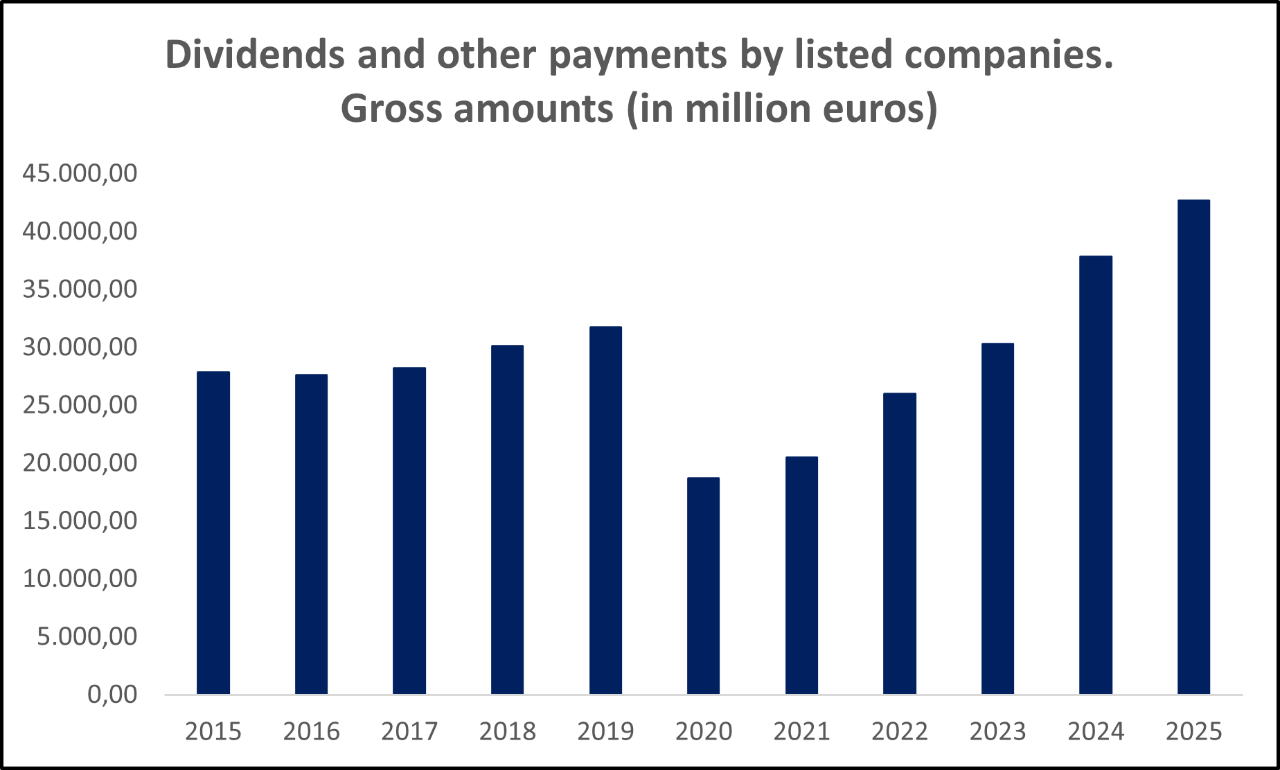
Dividend payments are discretionary corporate decisions. Companies choose to distribute dividends for several reasons. They may wish to reward shareholders with a stable and visible return, signal financial soundness, or avoid accumulating excessive cash holdings that produce a low yield. Dividend payments can also play a role in enhancing a company’s market attractiveness, especially for institutional investors who prioritize stable remuneration policies.
In many cases, a consistent or growing dividend is interpreted as a sign of confidence in the company’s long-term outlook and management quality, reinforcing market trust. Knowing when dividends are paid in Spain allows investors to assess the reliability and strategic orientation of their chosen companies.
Source: BME
What Are the Advantages of Dividend Payments for Investors?
Dividend payments offer several benefits that are especially relevant for investors seeking predictable or recurring income. They provide a regular cash flow that is independent of short-term price movements and can contribute to overall portfolio stability, as dividend-paying companies often exhibit more consistent financial behavior. Dividend payments also impose a measure of financial discipline on companies, encouraging prudent capital allocation. Over the long term, the reinvestment of dividends is a significant driver of total market return.
Nonetheless, dividend payments are not guaranteed and may be reduced or suspended during periods of economic stress or when companies need to preserve liquidity.
What Is the Taxation of Dividend Payments in Spain?
Understanding taxation of dividend payments in Spain is essential for calculating net returns. Dividend payments are taxed as investment income within the savings tax base. They are subject to withholding at the time of payment, and the applicable rates follow the progressive structure used for other financial returns. The tax treatment for nonresident investors may vary according to double-taxation treaties or the specific manner in which the shares are held. Investors should consider:
- Withholding tax on dividends in Spain
- Taxes on dividends in Spain
- Differences for nonresidents under double-taxation treaties
- Specific holding structures that may affect dividend taxation in Spain
Proper understanding of taxation is central to assessing the net yield of dividend-paying investments. This knowledge ensures investors correctly assess the effective yield from their dividend payment in Spain.
Dividend Payments: Essential for Corporate Governance
Dividend payments play a fundamental role in the relationship between companies and their shareholders. They serve not only as a mechanism of remuneration but also as a means of communicating financial strength, strategic confidence, and commitment to investor value.
Spain’s regulatory and infrastructural framework ensures that dividend payments are approved and distributed with transparency, prudence, and operational reliability. In an environment where clarity and financial discipline are increasingly important, dividend distribution in Spain remain an essential component of sound corporate governance.
Discover how dividend-paying stocks can enhance your trading strategy