Gas at BME Clearing

Gas Contracts

Contracts on Natural Gas and Liquefied Natural Gas, futures and day-aheads, registered in the CCP are Market and OTC transactions.

Both cases are agreements between two parties to buy or sell a specific quantity of gas on a future date at a fixed price.

The CCP provides a mechanism that guarantees the successful completion of operations for both counterparties. To facilitate trading, standard characteristics for contracts are specified.

How Are They Used?

There are three different types of trading strategies:

  • Hedging: these contracts are a tool for managing price risk. Buyers and sellers can hedge spot market positions against adverse price movements, mitigating or eliminating market risk. Hedging entails taking a forward position that offsets an existing position and may be total or partial.
  • Speculation: here the idea is to take on market risk in order to generate a profit by correctly betting on future price trends.
  • Arbitrage: this strategy entails simultaneous trading in various instruments in order to leverage temporary price distorsion. 

The existence of market participants with differing trading interests in respect of these contracts bolsters market liquidity and efficiency.

Features

The underlying asset of all types of Natural Gas Contracts is the ownership of Natural Gas at the Virtual Balancing Point, whose acquisition or disposal is carried out through a valid Notification of the transfer of ownership under the terms provided in the gas system regulations, which constitutes the object of Contracts with physical delivery on Gas.

The underlying asset of all types of Liquefied Natural Gas Contracts is the ownership of Liquefied Natural Gas at the Virtual Balancing Tank, whose acquisition or disposal is carried out through a valid Notification of the transfer of ownership under the terms provided in the gas system regulations, which constitutes the object of Contracts with physical delivery on Gas.

The Delivery Point or Tank of Natural Gas and Liquefied Natural Gas contracts is the virtual exchange area of the gas transport network where ownership transfers are carried out in the Spanish Gas System.

The registration unit is 1MWh/day (tick).1

The nominal or contract multiplier is established in MWh/d according to the formula:

Natural Gas

MWh/day * Number of contract days

Liquefied Natural Gas

MWh/day * the contract delivery day

The contract price is in Euros per MWh/d, with a maximum of 2 decimals.2

The delivery period of the different contracts is defined according to the following table:

Contract
Delivery Period
Future Natural Gas and Natural Gas referenced to TTF
Calendar, Season, Quarterly, Monthly, Balance of the Month (BoM)*, Weekly* and Balance of the Week (BoW)*
Day-Ahead Gas Natural
Daily*
Future Liquefied Natural Gas and Liquefied Natural Gas referenced to TTF
Daily deliveries during the next two months

*Only available for fixed-price Natural Gas futures.

Differences between the different products:

  • Balance of the Month, Balance of the Week, and Day-ahead contracts do not have daily Variation Margin, while future contracts do.
  • Calendar, Season, and Quarterly contracts expire through the cascade process (transforming into smaller contracts) which will be carried out two business days before the start of the delivery period.
  • Monthly and Weekly contracts will be settled through daily partial deliveries prepared from the business day before the first day of the contract delivery period.
  • Daily contracts, along with contracts from daily partial deliveries, expire the day before the contract, their nomination is made the day before the contract, and the delivery is settled on the same day of the contract (except for days that are Saturday, Sunday, or holidays).3

The delivery periods for an Annual, Seasonal, Quarterly, Monthly and Weekly contracts are the days covered, depending on the type of product:

Contract
Delivery Period
​ Day-Ahead
​​Day
​​Weekly
Full week: the first day will be on Monday and the last day will be on Sunday.
Balance of the Week: the first day will be D+1 (business day) and the last day will be the last day of the week.
Monthly
The first day will be the first day of the month and the last day will be the last day of the month.
Balance of the Month: the first day will be D+1 (business day) and the last day will be the last day of the month.
Quarterly
 The first day will be the first day of January, April, July and October, as applicable, and the last day will be the last day of March, June, September and December, as applicable.
Seasonal
 The first day will be the first day of October or April, as applicable, and the last day will be the last day of March or September.
Annual
The first day will be the first day of January and the last day will be the last day of December.

The nominal or multiplier of each Gas product depending on the days covered by the delivery period.

Nominal Gas Contracts

Delivery Period
Specific Period
Days
Nominal (MWh)
Day-Ahead
Normal
1
1
Week
Full
7
7
Month 
February 
28
28
February (leap year)
29
29
​​January, March, May, July, August, October and December
31
31
April, June, September and November
30
30
Quarter
First
90
90
First (leap year)
91
91
Second
91
91
Third
92
92
Fourth
92
92
Season
Summer
183
183
Winter
182
182
Leap Year Winter
183
183
Year
Normal
365
365
Leap Year
366
366

The product code is governed by the following rules:

Future Natural Gas
FG
​​Spread Natural Gas    
TG​
Day-Ahead Natural Gas
SG
Future Liquefied Natural Gas
FL
Spread Liquefied Natural Gas
TL
Auxiliary Liquefied Natural Gas
AL

For Gas contracts:

  • The first alphanumeric character indicates whether it is a Spot Contract (S), Future Contract (F), Spread Contract (T) or Auxiliary Contract (A).
  • The second character indicates that the underlying asset is Natural Gas (G) or Liquefied Natural Gas (L).
  • The third character indicates that the Delivery Area or Point is a Virtual Balancing Point (V) or Virtual Balancing Tank (T).
  • The fourth character indicates the specific Delivery Area or Point, which is Spain for the Spanish Virtual Balancing Point or Tank (S).
  • For contracts referenced to TTF, the fifth character indicates whether the reference is MA post-pricing delivery (M), MA pre-pricing delivery (N), or DA (D).
  • Then, it indicates whether the Delivery Period is annual (CAL), semi-annual (S), quarterly (Q), monthly (M), weekly (W), Balance of the month (BoM), Balance of the week (BoW), or daily (D).

*For more details, visit the Circular: C-ENE-2024-09-Contracts-listed-in-the-Gas-Products-Codification.pdf

The following contracts will be open by default:

Natural Gas:

  • Next five days.*
  • Next Balance of the Week contract on request.*
  • Weekly contracts on request.*
  • Next Balance of the Month contract in delivery.*
  • Next four monthly contracts.
  • Next four quarterly contracts.
  • Next two season contracts.
  • Next calendar contract.

BME Clearing may open other Delivery Periods for registration upon any Member's request.

*Only available for fixed-price Natural Gas contracts.

Liquefied Natural Gas:

  • Unique daily deliveries during the next two months.

Quarterly, season, and calendar contracts expire through the cascade process. This process breaks down contracts that are close to their expiration date into contracts with shorter delivery periods than the original contract, so that hedges can be made on those contracts with others that are in the registration period and therefore, settle the gas that covers the delivery period.

For gas, the last registration day is 2 business days before the start of the delivery period.

The cascade consists of the following:

  • After the last registration day of the contract, annual contracts close by converting into four quarterly contracts.
  • After the last registration day of the contract, season future contracts close by converting into two quarterly contracts.
  • After the last registration day of the contract, quarterly future contracts close by converting into three monthly future contracts.5

Liquefied Natural Gas Contracts Do Not Cascade

The setup below shows two examples of the cascade breakdown of a futures contract.

Open Position of Annual Contract 

FT– Annual
FT Q1
FT Q2
FT Q3
FT Q4
FT Q1

FT M1
FT M2
FT M3

Open Position of Seasonal Contract

FT– Seasonal
FT SS
FT SW
FT Q2
 FT Q3
FT Q4
FT Q1
FT M1
FT M2
FT M3


The shaded cells are contracts used to carry out the cascade to close the position.

      SS: Summer Season

      SW: Winter Season (Q1 corresponds with the first quarter of the following year)

The trades used to carry out the cascade do not generate fees. The Z trades are used at the daily settlement price.

Annual Contracts

The Annual futures contract is closed at the Annual final settlement price and the four Quarterly contracts are opened at the final settlement price of the Annual contract as well, which is equal to the Last Register Day.

Seasonal Contracts

The Seasonal futures contract is closed at the Seasonal final settlement price and two Quarterly contracts are opened at the final settlement price of the Seasonal contract as well, which is equal to the Last Register Day.

Quarterly Contracts

The Quarterly futures contract is closed at the Quarterly final settlement price and three Monthly contracts are opened at the final settlement price of the Quarterly contract as well, which is equal to the Last Register Day.

The Delivery of the Underlying Asset is carried out through the valid execution of the Gas Ownership Transfer Notifications, for each delivery day. BME Clearing or, where applicable, a Notification Service Provider, will send through telematic procedures to the System Technical Manager (Enagás) or TSO, in accordance with the gas system regulations, the information related to the Ownership Transfers of Natural Gas at the Virtual Balancing Point and Liquefied Natural Gas at the Virtual Balancing Tank corresponding to the Natural Gas and Liquefied Natural Gas Contracts cleared in BME Clearing.

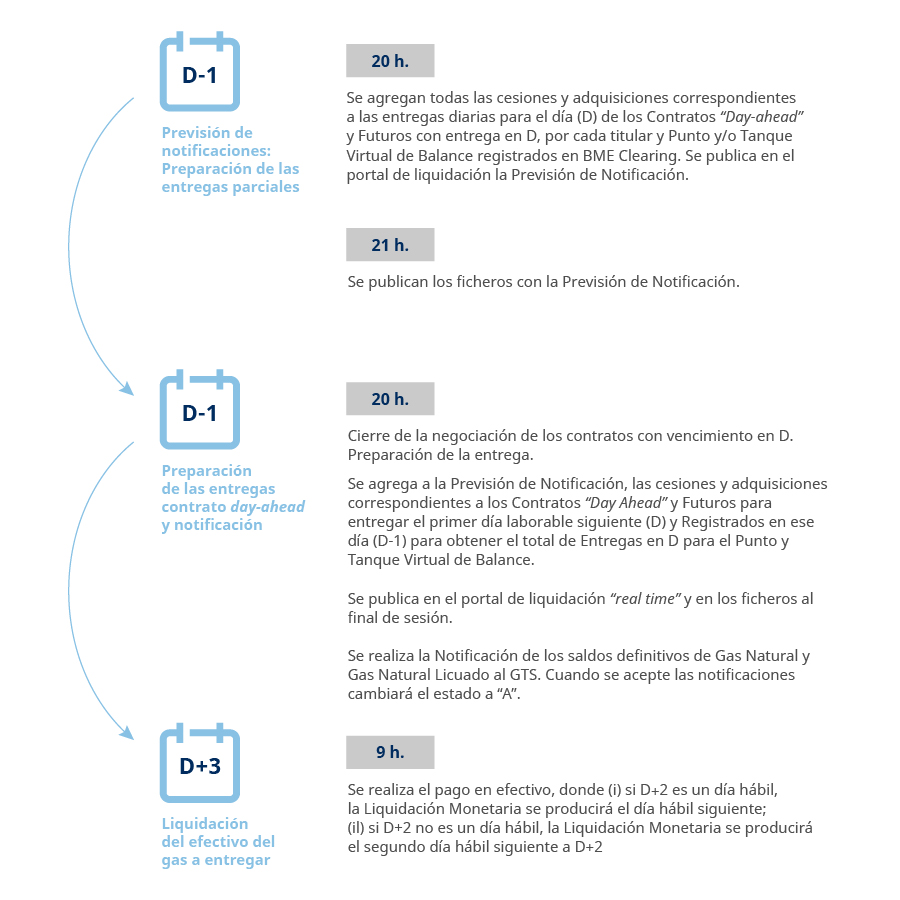
Monthly and weekly Natural Gas contracts are settled through daily partial deliveries prepared the business day before the first day of the contract delivery period.

For physical delivery (by notification to the TSO), all assignments and acquisitions corresponding to daily partial deliveries for the day (D) are aggregated, coming from the negotiation of day-ahead contracts and the breakdown of the Balance of the Week and Balance of the Month contract for each Balancing Account, in the delivery area or point registered in BME Clearing.

Liquefied Natural Gas contracts will not have a delivery period but a unique delivery on the agreed delivery day.

Procedure

Clarifications for delivery:

Preparation

  • "Preparation" refers to breaking down the monthly or weekly contract into a day (unless there are holidays). The operation is the same as the cascade, however, the concepts are presented separately to explain the peculiarities of the physical delivery preparation.
  • It is prepared/broken down on D-1, with D being the delivery day and D-1 being a business day.
  • When breaking down the contract encounters a holiday, the system searches until the next business day and breaks down that business day and all holidays encountered in the process.
  • The Margin due to delivery is calculated each day. In addition, it is calculated based on preparations for that day.
  • On the following day, the system must erode the following day that has to be prepared. If the following day to be prepared is a working day, the system stops there. If the following day is a Target holiday, the system will search for the following working day.

Nomination

Nomination is the process of communicating to the TSO the amount of Natural Gas to be delivered or received the next day. Nomination is always done on D-1 around 20:00 CET.

According to the gas system regulations, once the TSO communicates that it has accepted the nomination, the gas delivery is considered to have been made.

Delivery Settlement

The Monetary Settlement of the Delivery is carried out by applying the following rule: (i) if D+2 is a business day, the Monetary Settlement will take place the next business day; (ii) if D+2 is not a business day, the Monetary Settlement will take place on the second business day following D+2, through the multilateral settlement of BME Clearing.

1589_BME_Clearing_diagram

MEFFSTATION

MEFFSTATION terminal is the MEFF terminal associated with a specific operator. The terminals have all the necessary functionalities to check their position management.

The configuration option on the main MEFFSTATION menu enables an automatic download of files at the end of the session. Members can configure the files they wish to download, and the folder in which they wish to store them.

At any time during the session, members can force the generation of transfer files by using the "actions" option on the main menu. They will have information on files at the beginning of the session, or files that become available in the course of the day. Information on settlements and margins is only available at the end of the session.

Transfer files may be requested to BME Clearing if Members experience any problems with downloads.

The description of the Energy Sector trading transfer files is available "MeffStation Clearing Raw Data Files" document and User Manual Document are available in BME Clearing web, sector “About us” in the epigraph “Documentation – Technology”

BME-PC

BME CLEARING provides its Members a web portal for the Energy Segment with extensive information on the activities of the Clearing House, showing the details of the activity of each Member, such as trades carried out, open positions, settlement breakdown,  required margins, amongst other information.

The portal is accessed by a private password and code. If the member does not yet have these data or should you wish to request access for an additional user, please contact BME Clearing Helpdesk on + 34 91 709 58 60 or write to the following e-mail: clearinghelpdesk@grupobme.es.

The service is exclusive to BME CLEARING Members at no additional cost, in order to offer them quick access to information and statistics concerning their trades with the Clearing House. The results are shown in tables, and all information may be: ordered, filtered, grouped, concealed, reordered etc. In other words, it may be customised in accordance with the needs and preferences of each member. The reports displayed on screen may also be exported in a number of formats (txt, Excel or pdf, among others).

SFTP

Through the SFTP connexion, the end of day files may be downloaded (MEFFStation Settlement files). Those files contain information of the las five days, and they are renewed in such a way that they last five days are always available. Files are available once the market closes.

Contact Us

Do not hesitate to send us your inquiry. 

Software & Installation

BME Clearing Energy uses proprietary technology: The S/MART platform and the same central host as for other Electricity products.

BME Clearing Members gain access through:

  • TRAYPORT: BME Clearing has a clearing link connecting STP with Trayport and the OTF's so that trades can also be registered through the Trayport screens.
  • MEFFSTATION via a VPN connection: members gain access to Windows servers installed at BME's DPCs in Madrid (Las Rozas and Plaza de la Lealtad), where the MeffStation application is run.
  • BME-PC web portal: it is a web portal with information on trades carried out with the Clearing House.

BME CLEARING enables trades to be registered (Trade Register) as transactions directly agreed among Members (or among Account Holders) as below:

Bilateral Trade Register

BME – PC Energy

The Member registers a trade which counterparty is another member. BME Clearing sends the notification to the other counterparty requesting acceptance of the trade. The counterparty member has to accept the trade.

Through TRAYPORT

Gas trades are sent through Trayport by the OTF, and registered directly at BME Clearing, ie. no further confirmation is needed.

Those trades are taken into account in BME Clearing's Intra-day Risk Calculation for each counterparty.

Clearing & Settlemen

Open Position

Once a trade has been registered an open position is created. The open position has a serie of rules:

  • Trades with opposite sign for the same contract are offset; for example, buying two futures of Annual 2022 contract and  selling three futures from the same contract has an open position of one Annual 2022 sold future contract .
  • In segreggated client' accounts, which have a "gross record", different trades for the same contract are not offset; following the previous example, buying two futures of Annual 2022 contract and selling three futures from the same contract has an open position of two buying futures and three selling futures for Annual 2022 contract.

Although clearing occurs at the open position level, trades are live until the expiry date.


Daily settlements are carried out using a standard multilateral settlement in the Bank of Spain TARGET-2 System.

The Clearing Member is required to have an account in the TARGET-2 payments module. If it does not have one, it may designate a Payment Agent who has a treasury account in a Central Bank within the Euro System to settle through it.

Variation Margin

Variation Margin takes place for annual, seasonal, quarterly, monthly and weekly future natural gas contracts, as well as spread, auxiliary and daily fixed price liquified natural gas contracts.

During the life of a future contract, and up to the last day it is registered, a daily variation margin takes place, based on the difference between the settlement price and the last settlement price (for day-ahead trades: the price of the trade, for the rest: the settlement price of the previous session). On the last day of register, the Variation Margin calculation is based on the difference between the final settlement price and the last settlement price.

Settlement on Expiry

Settlement on expiry is carried out on day-ahead contracts.

The settlement takes place once the contract delivery period has ended. The generation of expiry operations (V) or (K) is carried out on the expiry day, which will correspond to the business day before the contract period. 

BME Clearing will determine the Daily Settlement Price of day-ahead contracts using the following information:

  • Purchase and sale prices and/or operations of Natural Gas products sent by a group of OTFs.
  • Prices of registered trades.
  • Long and short purchase and sale prices and/or operations of similar Natural Gas products traded on MIBGAS or other markets.

Settlement Fees

Registration and Clearing Fees

The fee for a trade is settled on the first business day following the trade registration and it may vary depending on the trade volume. It is calculated as follows:

    Fee = Trade volume * Contract Multiplier* Rate charged

Fees for Nomination and Physical Delivery

The delivery fee is settled the following business day of the expiry registration and it varies depending on the delivered volume. It is calculated as follows:

            Fee = Delivered Volume* Contract Multiplier* Rate Charged

In both cases,

  • Contract multiplier: number of MWh/d on a contract, identified in the corresponding contract type multiplier.
  • Rate Charged: amount per unit of the corresponding price (registration, clearing or delivery) to the type of registered trade, contract and holder concerned, in euro cents/MWh/d.


Margins Types

There are four basic margin components: Initial Margin, Individual Member's Margin, BME Clearing Margin and a contribution to the Default Fund by Members.

Scroll to left
Scroll to right

Initial Margin

It is calculated for each account. The Initial Margin is posted to BME Clearing for all open accounts in the Central Register and it is posted at a Clearing Member level if it is a segregated account in the Member's Second-Tier Register. This margin covers the risk of each position in extreme but plausible conditions.

How to calculate the initial margin:

There are 3 clearing groups for gas contracts:

  • Gas delivery (Day-Ahead contracts with 2 days until expiry).
  • Short Term Natural Gas (Day-Ahead contracts, Weekly and Monthly theoretical cascade).
  • Long Term Natural Gas (Annual, Seasonal, Quarterly and Monthly contracts).

Different intervals are established within each margin class:

Theoretical Cascade

For those contracts whose delivery period is  wholly or partially contained within the delivery period of another contract, and have positions of opposite sign, will have an offset priority and  spread margins will be equal to 0.

Based on the theoretical cascade process defined in BME Clearing's Theoretical Cascade Instruction, or any instruction replacing it, and according to the rules defined in such Instruction, contracts are broken down into smaller parts (contracts with a smaller delivery period), with the offset of identical contracts with opposite position, remaining as a result the net position (long or short delta) and a spread margin equal to 0.

Unlike the actual cascade, the Theoretical Cascade will be carried out for contracts in delivery and for contracts moving to front. The list of contracts is as follows:

  • Monthly contracts will be broken down into Day-Ahead contracts.
  • Weekly contracts will be broken down into Day-Ahead contracts.

Margins due to delivery of Gas

These are calculated based on the balances obtained in the holder's physical delivery/receipt file.

The forecasted deliveries for D are prepared on D-2 at 08:00 pm.

All sales and purchases are aggregated corresponding to daily partial deliveries for the day (D) on Day-Ahead Contracts and Futures Contracts with delivery at D, for each holder and VBP registered with BME Clearing.

Margins are required to be deposited in D-2 so that they can be posted in the multilateral settlement with value date D-1. Therefore, for the D nomination, on D-1at 06:00 pm, the Member with net disposing balance would already have the margins posted and BME Clearing could handle a Default. Likewise, the Member with net acquiring balance would have advanced the margins in D-1 to cover an imbalance.

Due to changes in the Spanish Gas System Regulations, the Monetary Settlement date will be modified from D to D+3 where, (i) if D+2 is a business day, the Monetary Settlement will be carried out the following business day; (ii) if D+2 is not a business day, the Monetary Settlement will take place on the second business day following D+2. In the case of a Member with a net disposing balance, no additional required margins will be needed since that said Member has complied with the physical gas delivery. Conversely, for a Member with net disposing balance, margins must be posted until D+2, with the subsequent settlement on D+3 to address any potential default. 

In terms of systems, this type of margin is calculated the same way; however, it corresponds to a different array that would not have offsetting percentage with the other margin classes, except for the case when it is covered by a positive Variation Margin pending in the segment.

Intra-Commodity Spread

Opposing positions in contracts with different maturities within the same group of contracts are netted, for example: for example, a long March base contract with a short Quarterly base contract. To this end, the offset MWh/d are calculated and the initial margin offset within the same margin class is applied to them, and the non-offset MWh/d are calculated and the full margin is applied to them.

The intra-array offset within the same margin class, which is applied within each group of contracts, is the maximum between a fixed amount and the price difference of the contracts.

If there is more than one pair of contracts to be compensated, priority is given to the pair of contracts with the same maturity date. In this case, the contract types with the higher multiplier are first offset. If there are contracts with different maturity dates, priority is given to the pair of maturities with the closest maturity dates to each other, since they are the most correlated. If there is more than one pair and the distance between contracts in the same pair is the same between pairs, the furthes expiry date is prioritised.

Inter-Commodity Spread

There is also compensations within different margin classes. The margin credit or discount is calculated taking as reference the minimum fluctuation of each group.

A monthly review is conducted of price volatilities, and parameters are established for the margin calculation. They are published in the Circular "Parameters for the calculation of Initial Margin".

Cash Adjustment

Contracts which do not have a daily Variation Margin (Balance of the Month, Balance of the Week and Day-Ahead contracts) are also subject to Mark-to-Market adjustment margin. In other words, these contracts do not have a daily Variation Margin but the market value of these contracts has varied with regard to the price that was originally contracted. For this reason, this variation margin is not settled in cash but is taken into account, to a greater or lesser extent, when calculating the initial margin.

members and participants Area

Access to the MEFF Platform

Access to the BME Backoffice Portal